


Does astigmatism get worse with age?
Astigmatism sounds like the name of a dance move, but it's actually one of the most common vision problems people have. And it gets more common with age. Around 8% of children worldwide show signs of the condition, but it's found in more than 62% of people aged 70 and over (as if getting older wasn't already a bummer). The condition makes everything look blurry, which tends to get worse over time.
Does astigmatism get worse with age (like almost everything else)? And is it normal for astigmatism to get worse over time? The answers aren't as simple as yes and yes (though sort of...) Let's go over what's known and maybe it will all become clear (see what we did there?).
Understanding the progression of astigmatism
Astigmatism can appear at any age, but it's more common in older groups. Here's what you need to know.
Astigmatism overview
In healthy eyes, images form after light passes through the lens and lands on the light-sensitive section in the back (scientific name: "the light-see-thingy," except in Greek). In people with astigmatism, this light gets bent in odd ways by the curvature of the lens or cornea. The disruption causes blurry vision by scattering light.
There are two types of astigmatism based on which direction the bending is going. With-the-rule astigmatism happens when the eye’s lenses bend light horizontally, while against-the-rule astigmatism involves vertical light bending, causing distortion.
Renew your prescription online with ExpressExam Renew your prescription online with ExpressExam 
Get an online vision exam from 1-800 Contacts
Get an online vision exam from 1-800 Contacts
Age-related astigmatism
Astigmatism doesn’t just sit there politely your whole life — it can shift as your eyes age. Age-related astigmatism is simply the gradual change in the shape of your cornea (or lens) over time, which can tweak how light focuses in your eye. For some people, that means slightly blurrier distance vision. For others, it shows up as more glare at night or letters that look a little shadowed. These changes are usually subtle and slow-moving, but they’re common. As birthdays stack up, your eyes evolve, too — sometimes quietly, sometimes annoyingly.
Does astigmatism get worse with age?
Many people ask this question after noticing their prescription creeping up year after year. While some people are born with noticeable astigmatism, it shows up gradually for many and becomes more obvious over time. Astigmatism with age is a real thing — but it’s not a straight, dramatic downhill slide for everyone.
Does astigmatism get better with age?
In general, the tendency is for astigmatism to shift as you get older. That doesn’t automatically mean it will skyrocket. In fact, when people ask if astigmatism gets better with age, the honest answer is: sometimes, temporarily. The shape of your cornea can subtly change over decades, and even the constant pressure from your eyelids plays a role (apparently "heavy eyes" isn’t just poetic metaphor). Vertical astigmatism often lessens a bit over time because of that pressure, while horizontal astigmatism tends to increase.
At what age does astigmatism worsen?
The short answer is that there isn’t a single magic number. Many people notice shifts in their 40s and 50s, partly because the natural aging process affects the entire eye. The key thing to watch for is rapid change. Small adjustments in your prescription are common. Big, sudden swings? That’s your cue to check in with your eye care professional to make sure nothing else is going on. If you have the condition and it rapidly gets better or worse, you might want to check in with an eye care professional who can evaluate the issue.
Optimal times to wear glasses for astigmatism
Glasses are the first line of attack for dealing with astigmatism. These must be prescribed for you, usually after an in-depth eye exam.
Recognizing the need for glasses
The first sign you need glasses for astigmatism is usually blurry vision. This can be mild or severe. The scattering of light at the back of the eye can also cause aberrations in brightness, sometimes creating halos or auras around bright objects (which is less fun than it sounds). You might also get headaches from the constant eyestrain.
Glasses can correct some of the distortion. So can contact lenses, at least for mild to moderate astigmatism. Your prescription might have to be adjusted over time as the severity of your astigmatism advances because that's the fun way aging usually works.
Addressing vision changes
Correcting astigmatism can be really important. Driving, for instance, can be dangerous if your vision isn't corrected. You might also need solid vision correction for work or even just to read.
Get premium eyeglasses frames starting at $79 Get premium eyeglasses frames starting at $79 
The Framery at 1-800 Contacts
The Framery at 1-800 Contacts
Factors influencing astigmatism changes
Astigmatism tends to change over time. Some of this is gradual, but it can also happen quickly. A lot of the time, your astigmatism will change in response to something in the environment you can control.
Age-related eye changes
With-the-rule astigmatism tends to get worse with age as the horizontal elliptical distortion advances. This produces a more pronounced blur and halo effect. Against-the-rule astigmatism does the opposite, as the vertical distortion tends to flatten out, but it doesn't always. Any kind of vision changes like these should send you back to the eye care professional's office for a prescription adjustment.
Lifestyle and environmental factors
Astigmatism changes with the curvature of the eyes, and anything that affects that can cause changes in vision. Reading under low-light conditions, for example, can gradually cause increased strain that eventually pulls the eyes into a more severe ellipse (see, Mom? Reading isn't all it's cracked up to be.). Detail work, such as sewing, can have a similar effect and should only be done with good lighting to work by.
Aging with astigmatism
Astigmatism can happen at any age, but you're more likely to have it as you get older. Most cases get more severe over time, as the eyes continue to bend outside the proper curvature. If you have symptoms of astigmatism or your condition gets worse, set up an eye exam and get the help you need.
With everything you can do online these days, it only makes sense that you can renew your contact lens prescription. How do online eye exams work? How long is a prescription good for? Find out when yours expires and how to renew it within minutes. Don’t let an expired prescription leave you squinting. Can you get contacts without a prescription? No. But all is not lost. Find out more about getting contacts. Everything you need to know about online vision exams
How ExpressExam really works
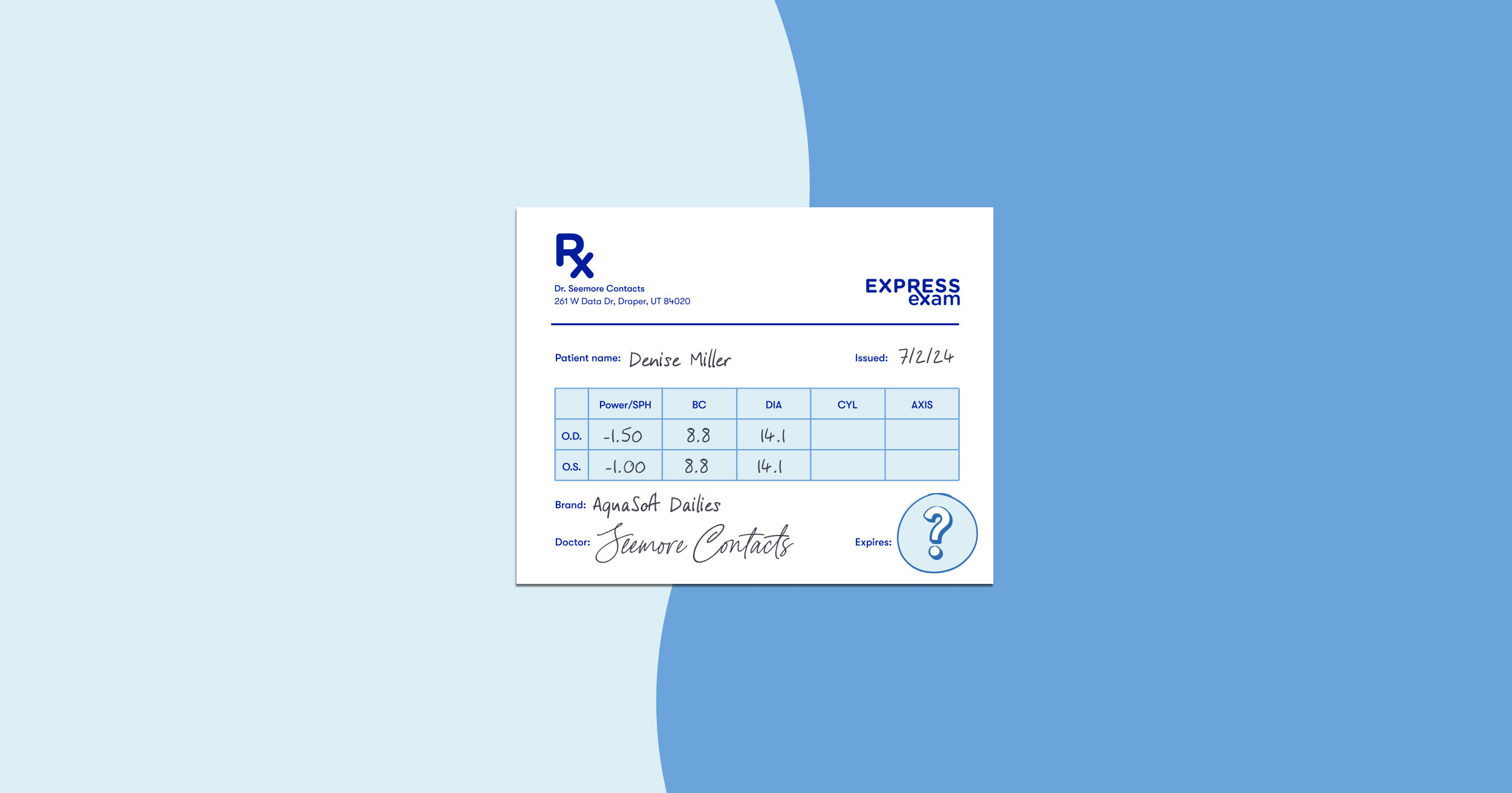
How long is my prescription good for?

Can I order contact lenses with an expired prescription?
Did you know you can order contacts online?
Say goodbye to trips to the eye doctor and hello to convenience! With 1-800 Contacts, you can easily order your contact lenses online and have them delivered straight to your door. Plus, our online vision exam makes it simple to get the prescription you need without leaving home. And the best part? You’ll save money on your first order with 1-800 Contacts. It’s never been easier to get your contacts!
FAQS
Is astigmatism present from birth?
The curvature that causes astigmatism can be present at birth, especially vertical astigmatism. It's more likely to be diagnosed later in life, however. With-the-rule astigmatism has a definite tendency to worsen with age for most people, eventually causing noticeable symptoms in 62% of seniors aged 70 and over.
Can astigmatism be completely corrected with glasses, or are other interventions necessary?
For some people, glasses or contact lenses are enough to handle astigmatism, especially during the early stages. Refractive surgery, which can involve a scalpel or laser, also works.
Can lifestyle changes, such as diet or exercise, impact astigmatism progression?
There aren't a lot of lifestyle changes that can dramatically affect how astigmatism impacts vision. Reading larger print under good light is one such change, as is avoiding small print where you have to strain to see for long periods of time.
Original publish date: 5/1/2024
Updated date: 4/13/2026