


How to manage myopia (nearsightedness)
Managing myopia starts with a simple explanation that somehow still feels unfair: You can read a label on a shampoo bottle from 2 feet away, but a road sign across the street looks like it was printed on a cloud. That’s myopia, also known as nearsightedness. It happens when light entering your eye focuses in front of the retina instead of directly on it, which makes far-away objects look blurry.
Myopia comes in different forms and levels. Mild myopia may change slowly or barely at all. Progressive myopia tends to worsen over time, especially during childhood and the teen years when eyes are still growing. High myopia is more severe and can raise the risk of certain vision problems later on, which is why slowing progression can be so important.
You’ll also hear a few terms that sound similar but mean different things:
-
Progression: Means myopia is increasing over time, so the prescription gets stronger
-
Treatment: Involves correcting blurry vision right now, so you can see clearly today
-
Management: Uses strategies to slow progression over the long term
What causes myopia to worsen?
Myopia usually worsens when the eye continues to grow longer, which shifts how light focuses and increases blur at a distance. That growth can be influenced by genetics, environment, daily habits, and timing. Most people aren’t dealing with one single cause. It’s usually a handful of factors working together, like an unhelpful little team project.
Here are the most common reasons myopia can progress:
-
Genetics
-
Lots of near work
-
Not enough time outside
-
Early onset
-
Too few breaks
-
Growth spurts
Myopia management
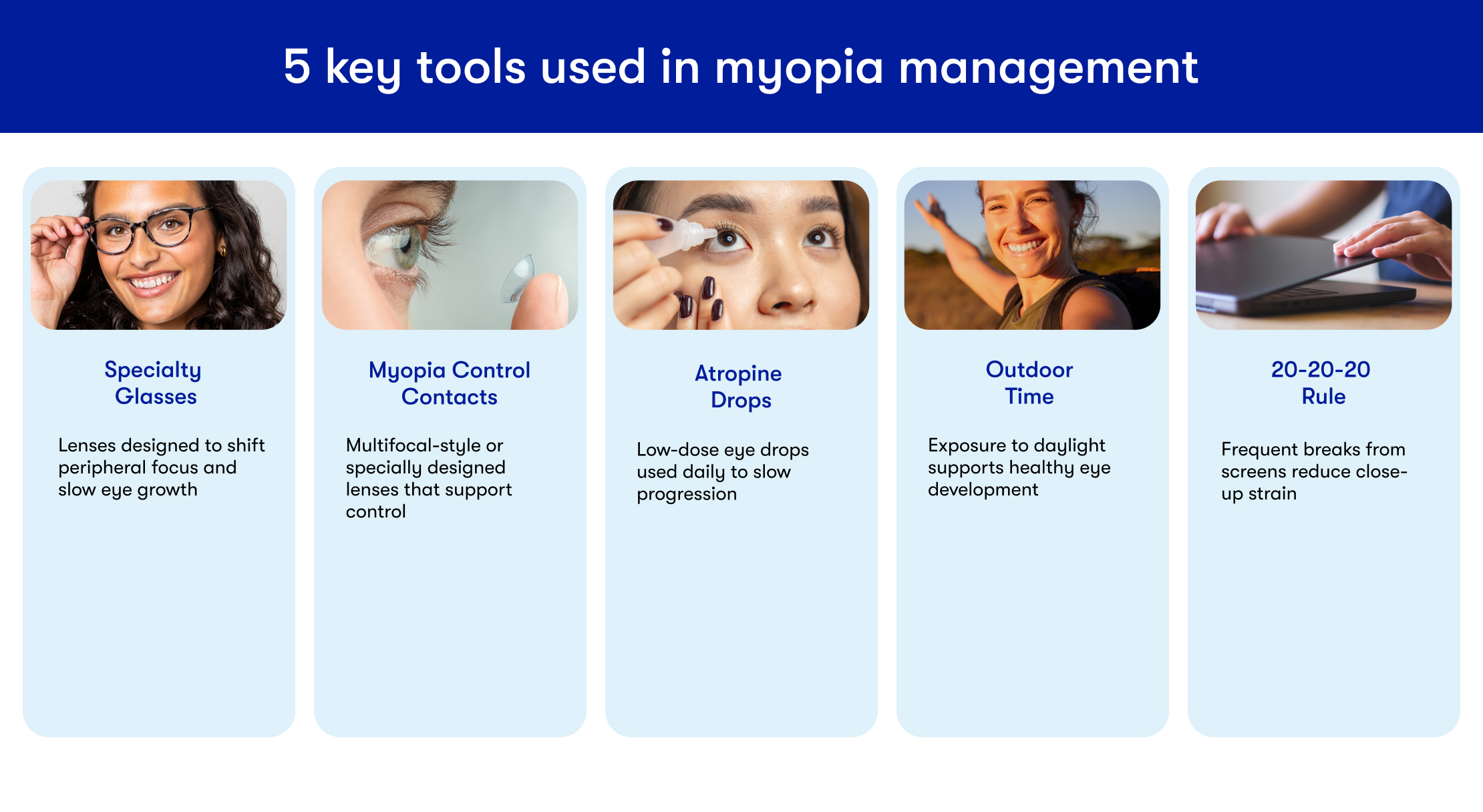
Myopia management is a plan designed to slow the progression of nearsightedness, especially during childhood and teen years. It’s not only about sharper vision today. It’s also about reducing how quickly the prescription changes over time, which may help lower the risk of complications linked to high myopia later in life.
Most myopia management plans include a mix of approaches. Here are the common categories:
-
Early detection and starting at the right time
-
Special glasses and contacts
-
Atropine eye drops
-
More time outside
-
Observing the 20-20-20 rule
-
Regular monitoring and eye exams
Early detection and starting at the right time
You should start myopia management as soon as myopia is diagnosed by an eye care professional, especially in children.
Early detection usually includes:
-
A full eye exam and prescription measurement
-
A baseline to track changes over time
-
A conversation about risk factors such as family history and daily habits
If your child squints at far-away objects, moves closer to screens, or complains that distant vision is blurry, it’s worth scheduling an exam sooner rather than later. Waiting for it to work itself out tends to be about as effective as waiting for a cracked phone screen to heal through positive thinking.
Special glasses and contacts
Special glasses and contacts can be a core part of myopia management because they do more than correct blurry vision. Certain lens designs are made to change how light focuses across the retina, which may help reduce the signals that encourage the eye to keep growing longer.
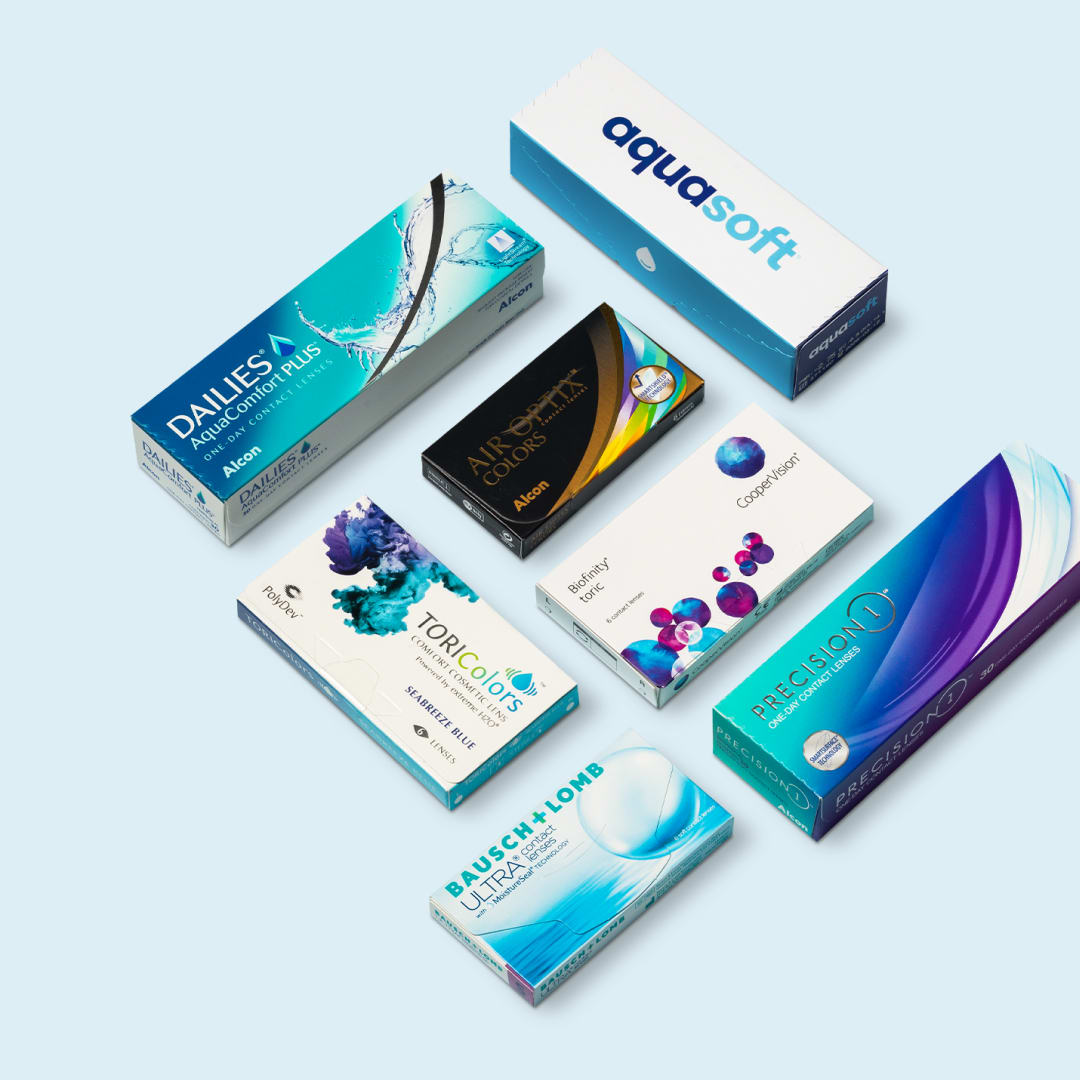
Order Contact Lenses Online
Learn how to order contact lenses online at 1-800 Contacts
Order contacts
Myopia management contacts
Myopia management contacts are specialty contact lenses designed to correct nearsightedness while also helping slow progression. Depending on the plan, these may include multifocal-style designs or other lens technologies recommended by your eye care professional.
Myopia management glasses
Myopia management glasses are designed to correct nearsightedness while supporting myopia control through specialized lens designs. They look like normal glasses, but the lens technology differs from standard single-vision lenses.
Glasses can be a strong choice for younger kids, families who want a simpler routine, or anyone who prefers low maintenance. No cleaning solution, no tiny cases, and no misplaced contact lens panic right before school.
Atropine eye drops
Low-dose atropine is often chosen because it may slow progression while reducing side effects compared to higher-dose atropine. Still, it’s a daily routine and works best when used consistently.
Potential benefits include:
-
A non-lens option that can support myopia management
-
The ability to pair with glasses or contacts
-
A simple daily habit once it becomes routine
Things to consider include:
-
Drops need to be used consistently to be effective.
-
Some kids may experience light sensitivity or focusing changes.
-
Follow-up visits matter to track progress and adjust the plan.
More time outside
Spending more time outside is one of the simplest lifestyle changes that can support myopia management, especially for kids. Outdoor time encourages distance viewing and provides natural light exposure, both of which may help slow progression.
This doesn’t require turning your child into a wilderness explorer. It can be as simple as:
-
Playing outside after school
-
Walking the dog
-
Going to the park
-
Participating in outdoor sports or bike rides
The 20-20-20 rule
The 20-20-20 rule is a simple habit that helps reduce eye strain from close-up work.
Every 20 minutes, look at something about 20 feet away for 20 seconds.
It’s quick, free, and surprisingly helpful for kids who spend a lot of time using screens. This rule doesn’t replace other myopia management tools, but it supports healthier visual habits by giving the eyes regular breaks from close focusing.
Easy ways to make it stick:
-
Set a timer during homework time.
-
Use natural breaks between assignments.
-
Pair it with a quick stretch or water break.
It’s basically a mini reset button for your eyes, and it’s a lot easier than trying to convince a kid to "just blink more." (That advice has never helped anyone.)
Regular monitoring and eye exams
Regular monitoring is a key part of myopia management because progression can change over time. Kids can go through growth spurts, routines can shift, and a strategy that worked last year might need adjustments now.
Eye exams help track:
-
Prescription changes over time
-
How quickly myopia is progressing
-
Whether current glasses, contacts, or drops are working
-
Whether the plan needs to be updated
Myopia management costs
Myopia management costs depend on the approach you choose, the products involved, and how often follow-ups are needed. Some families stick with specialty glasses and regular monitoring. Others use contacts, atropine drops, or a combination plan.
Here’s a realistic ballpark range:
-
Eye exams and follow-ups: Often $100 to $300+ per visit
-
Myopia glasses with specialized lenses: Often $200 to $600+ per year
-
Myopia contacts: Often $500 to $1,500+ per year
-
Atropine eye drops: Often $200 to $600+ per year
-
Total yearly range for many plans: Roughly $500 to $2,000+
Can myopia lead to blindness?
Myopia can increase the risk of serious eye conditions that may threaten vision, especially with high myopia, but most people with mild or moderate myopia don't go blind from it. Higher levels of myopia are linked to increased risk of issues like retinal detachment, glaucoma, and myopic macular degeneration. That’s why myopia management matters. Slowing progression early may help reduce long-term risk and support healthier eyes over time. Regular eye exams, a plan from an eye care professional, and consistent habits such as outdoor time and screen breaks can all help protect your vision for the future.
See how to get free shipping on affordable lenses, as well as the time it takes to get them and how to save time and money on the entire process. How much are contact lenses? Compare the prices of daily, weekly, biweekly, and monthly contact lenses and find the best option for you. See where to order contacts online, according to price and shipping times. Compare top online retailers to find the best deal for you. Everything you need to know about contact lenses
Free shipping for contact lenses

How much do contacts cost?
Where to order contacts online