


What are sanpaku eyes?
Sanpaku eyes are also known as "three eyes" in Japanese culture. While this description may conjure a spooky visual, they're actually quite common, and you likely know someone with sanpaku eyes without realizing it.
Sanpaku eyes carry cultural significance, especially in East Asian traditions, where some people believe that the visibility of more sclera (the white part of the eye) above or below the iris can offer insights into a person's physical and emotional state, or even predict future fortune or challenges. This belief has become part of both folklore and pop culture, adding an extra layer of fascination to an otherwise normal trait.
Sanpaku Eyes Definition
Sanpaku eyes are a natural eye appearance where the white part of the eye (sclera) is visible above or below the iris instead of only on the sides. The term comes from Japanese culture and means “three whites,” referring to the sclera showing in three visible areas around the iris.
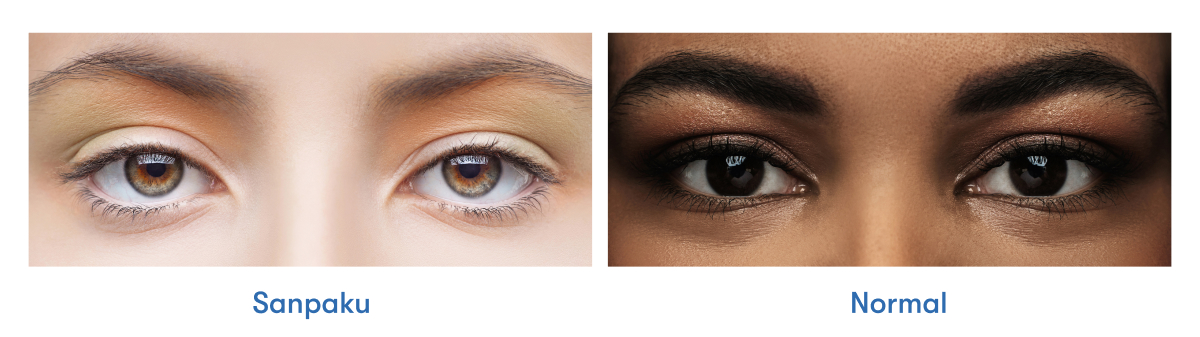
“Normal” eyes vs. sanpaku eyes
Most eyes are considered “normal” even when the white part (sclera) is visible on either side of the iris and just a little above or below. In contrast, people with sanpaku eyes have extra white visible either above or below the iris. So, while “normal” eyes show less sclera, sanpaku eyes have a distinctive look because there’s noticeably more white showing, usually below the iris. Both are natural variations, just different in appearance.
Different types of sanpaku eyes
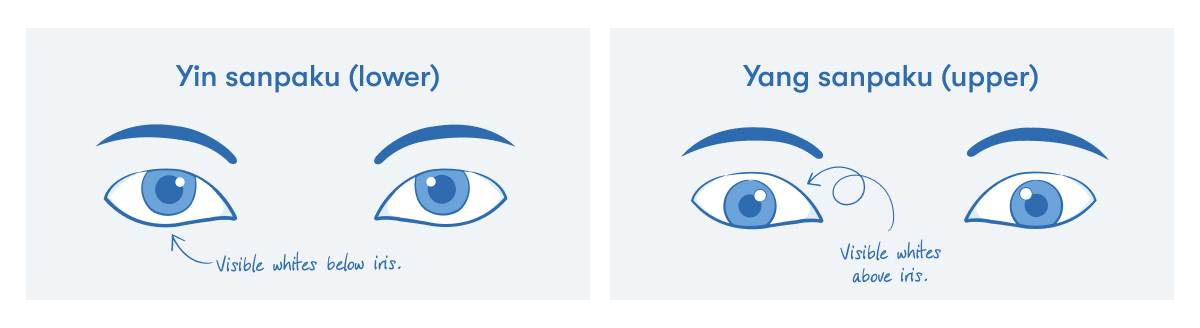
There are two main types of sanpaku eyes: yin sanpaku and yang sanpaku.
Yin sanpaku eyes
Yin sanpaku eyes are the more common type, with the whites showing below the iris. In Japanese culture, yin sanpaku eyes are associated with physical imbalances, sensitivity to external stimuli, mystery, and intense emotions.
Marilyn Monroe is an example of a celebrity with yin sanpaku eyes.
Yang sanpaku eyes
Yang sanpaku eyes are less common and are characterized by the whites of the eyes showing above the iris. They're associated with a dominant personality and are mentally or physically aggressive. Yang sanpaku eyes are typically seen less favorably than yin sanpaku eyes.
To reinforce the whole dominant and aggressive belief, a famous example of yang sanpaku eyes is Charles Manson.
How common are sanpaku eyes and is it rare?
It's unclear how prevalent sanpaku eyes are worldwide. A 2020 study examined 123 participants without eye diseases and found that about 50% had sanpaku eyes. However, your high school science teacher would probably scoff and tell you that's too small of a sample size to be conclusive.
Learn how to order contact lenses online at 1-800 Contacts
What causes sanpaku eyes?
Sanpaku eyes aren't usually a sign of an eye issue. People can get sanpaku eyes for various reasons, including:
- Genetics: You can be born with sanpaku eyes.
- Age: You may develop sanpaku eyes as you age.
- Medications: Some medications can cause sanpaku eyes to develop.
- Disease: Some medical conditions and diseases, such as corneal arcus, eye cancer, eye trauma, hormonal imbalances, or Graves' disease, can cause sanpaku eyes.
- Other conditions: Substance abuse, sleep issues, and complications from eye lift surgery can cause sanpaku eyes.

If you suddenly develop sanpaku eyes, it's worth scheduling an eye exam. An eye care professional can ensure the sudden change isn't associated with a disease or medical condition.
Are sanpaku eyes bad?
Remember what your mom taught you... you're special just the way you are.
Sanpaku eyes aren't bad. Whether you were born with them or developed them later in life, it's simply how your eyes look. Of course, suppose your sanpaku eyes are a result of an underlying health concern or condition. In that case, you might naturally have a negative connotation toward them, and we can't blame you for that.
Your feelings about sanpaku eyes might also be determined by your culture. For example, sanpaku eyes are seen as bad luck in Japan but good luck in China.
What does research say about Sanpaku eyes?
If you’ve come across the term “Sanpaku eyes,” you might be wondering what it really means and whether there’s any science behind it.
In short, Sanpaku eyes describe when the white part of your eye (the sclera) is visible either above or below the colored iris. While some people link this look to superstitions or personality traits, there’s no credible scientific evidence connecting Sanpaku eyes to specific health conditions or outcomes. Eye shape and sclera visibility typically come down to natural differences in facial structure or benign variations, and not to predictions about your well-being or future.
From a medical perspective, sanpaku eyes are not considered a diagnosis or condition. Ophthalmology does not classify sanpaku eyes as a disorder. Instead, scleral visibility is typically related to facial anatomy, eyelid position, and natural variation in eye structure.
If you have concerns about your eyes or vision, the best step is to check in with a qualified eye care professional who can give you accurate, personalized advice.
Learn how to order contact lenses online at 1-800 Contacts
Sanpaku eye origins and history
The word "sanpaku" came into wider use in 1965, thanks to Japanese author George Ohsawa. In Japanese, “sanpaku” means “three whites.” It describes when you can see extra white area (the sclera) on three sides of the colored part of your eye (the iris).
Ohsawa wrote about sanpaku eyes in his book, You Are All Sanpaku. He said this trait was a sign of a problem in the body or spirit. Ohsawa even claimed he could predict the lives of famous people like President John F. Kennedy and Marilyn Monroe just by looking at their eyes. Like many old ideas that try to link looks with fate, it’s smart to remember that these are just interesting stories and not medical facts.
Cultural significance and beliefs about sanpaku
In Japanese culture, people have long practiced face reading. This is when someone tries to learn about a person’s character or future based on facial features. Eyes are especially important in this tradition and Sanpaku eyes got special attention. There are two types: yin sanpaku (white under the iris), which some thought meant trouble ahead, and yang sanpaku (white above the iris), which was linked to strong or unpredictable personalities.
Over time, beliefs about sanpaku eyes have changed a lot. In many places today, these ideas are mainly for fun or part of pop culture. Sanpaku eyes appear in anime, movies, and stories about celebrities, usually to make a character look mysterious or different.
Now in Japan, most young people don’t believe in these superstitions anymore. For most, sanpaku eyes are just a natural feature, like having curly hair or big ears. If you see sanpaku eyes in the mirror or on someone else, remember that many happy, healthy people have this trait.
Evolution and variation of sanpaku eye beliefs
What people think about sanpaku eyes has changed over the years. In the past, some believed it gave clues about a person’s future or temper. Today, it’s more about style or personality. You’ll hear about sanpaku eyes more often in anime or fashion than from fortune tellers.
People now see sanpaku eyes in lots of different ways. Some think the look is cool or unique, like the main character in a TV show. Others, especially older folks, may remember the older beliefs, but these stories are mostly just tradition.
As cultures mix and change, the meaning of sanpaku eyes keeps shifting. In the end, sanpaku eyes are just one part of what makes faces interesting. Whether you have them or just like how they look, you’re not alone, many people share this feature.
Famous people with sanpaku eyes
Some of the most famous people with sanpaku eyes are:
- Sylvester Stallone
- Billie Eilish
- Aubrey Plaza
- Princess Diana
- Jeremy Allen White
- Lalisa Manoban (Lisa)
- Michael Jackson
- Anya Taylor-Joy
- Elvis Presley
- Takeoff
Okay, sure, some on this list have had tragic fates, but plenty have led inspiring and successful lives, so there’s no reason to worry.
How to tell if you have sanpaku eyes
After all that, you have to be wondering if you have sanpaku eyes. Look straight into the mirror. Can you see any whites above or under your iris? If so, you have yin or yang sanpaku eyes.
And remember, even if you don't have them now, something as simple as naturally aging or developing insomnia might cause you to develop sanpaku eyes.
Whether you have them or not, remember that sanpaku eyes are just about the physical appearance of your eyes. They don't cause your vision to worsen or change the shape or structure of your eye. This means you can continue wearing your regular contacts and glasses even if you eventually develop sanpaku eyes. So, continue to refill your contacts at 1-800 Contacts without issues, sanpaku eyes or not.
And now that you know everything you can possibly know about sanpaku eyes, we guarantee you'll stare deep into everyone's eyes going forward — which everyone is going to either take as flirting or unsettling behavior. You've been warned.
See how to get free shipping on affordable lenses, as well as the time it takes to get them and how to save time and money on the entire process. How much are contact lenses? Compare the prices of daily, weekly, biweekly, and monthly contact lenses and find the best option for you. See where to order contacts online, according to price and shipping times. Compare top online retailers to find the best deal for you. Everything you need to know about contact lenses

Free shipping for contact lenses

How much do contacts cost?

Where to order contacts online
Frequently Asked Questions About Sanpaku Eyes
Are sanpaku eyes rare?
No, sanpaku eyes are not rare. Many people naturally show some white above or below the iris. While exact prevalence isn’t well documented, sanpaku eyes are considered a normal variation in eye appearance rather than an uncommon trait.
Are sanpaku eyes a medical condition?
No. Sanpaku eyes are not a medical diagnosis or disorder. In medicine, visible sclera above or below the iris is simply a variation in eye anatomy and facial structure. In most cases, it has no impact on eye health or vision.
Can sanpaku eyes affect vision?
Sanpaku eyes themselves do not affect vision. They are related to the appearance and positioning of the eye, not how the eye functions. Vision problems are typically caused by refractive errors or eye conditions, not scleral visibility.
What causes sanpaku eyes?
Sanpaku eyes can be caused by genetics, natural facial structure, aging, eyelid positioning, or changes in muscle tone around the eyes. In rare cases, medical conditions, trauma, or certain medications may contribute to increased scleral visibility.
Did you know you can order contacts online?
Say goodbye to trips to the eye doctor and hello to convenience! With 1-800 Contacts, you can easily order your contact lenses online and have them delivered straight to your door. Plus, our online vision exam makes it simple to get the prescription you need without leaving home. And the best part? You’ll save money on your first order with 1-800 Contacts. It’s never been easier to get your contacts!
Original publish date: 7/25/2023
Updated date: 1/29/2026