


What does high-index mean for glasses?
Glasses lenses all have a refractive index. Don't worry, we're not joining a high school physics lesson for this post. What you really need to know is that the index is a measure of how efficiently the lens material bends light. A higher index means greater efficiency.
We'll explain why that matters in this blog. Right now, just know that common index levels include:
-
Standard: Around 1.50
-
Mid-index: Around 1.60
-
High-index: Around 1.67
-
Ultra-high index: 1.74
Keep reading to learn what these numbers actually mean, why you might need high-index lenses, and whether high-index glasses have downsides.
What are high-index lenses, by the numbers?
When lens material bends light more efficiently, you need less material to do the same light bending. Glasses work to correct vision by bending the light (and thus the images) coming toward your eye before they enter your eye. People with higher prescriptions usually need more "bending," so it's helpful when glasses can be made of a material that gets the job done with less.
Here's a practical breakdown by the numbers:
-
Standard (1.50): Standard lens materials are often used for lower prescription strengths. The resulting lens is heavier and thicker compared to a similar lens made of higher-index options.
-
Mid-index (1.56 or 1.59): Mid-index lenses are slightly lighter and thinner than equivalent standard lenses. Lenses with a 1.59 index are typically polycarbonate, a material that's popular for kids' glasses or for those active in sports due to its durable nature.
-
High-index (1.61 or 1.67): When high-index lenses are recommended due to a strong prescription, here's where you normally fall. These lenses are typically around 30% thinner than lower index options, which reduces bulk and "coke-bottle" effects.
-
Ultra-high index (1.74): You can get even higher index lenses than 1.67, and these options are usually reserved for strong prescriptions.
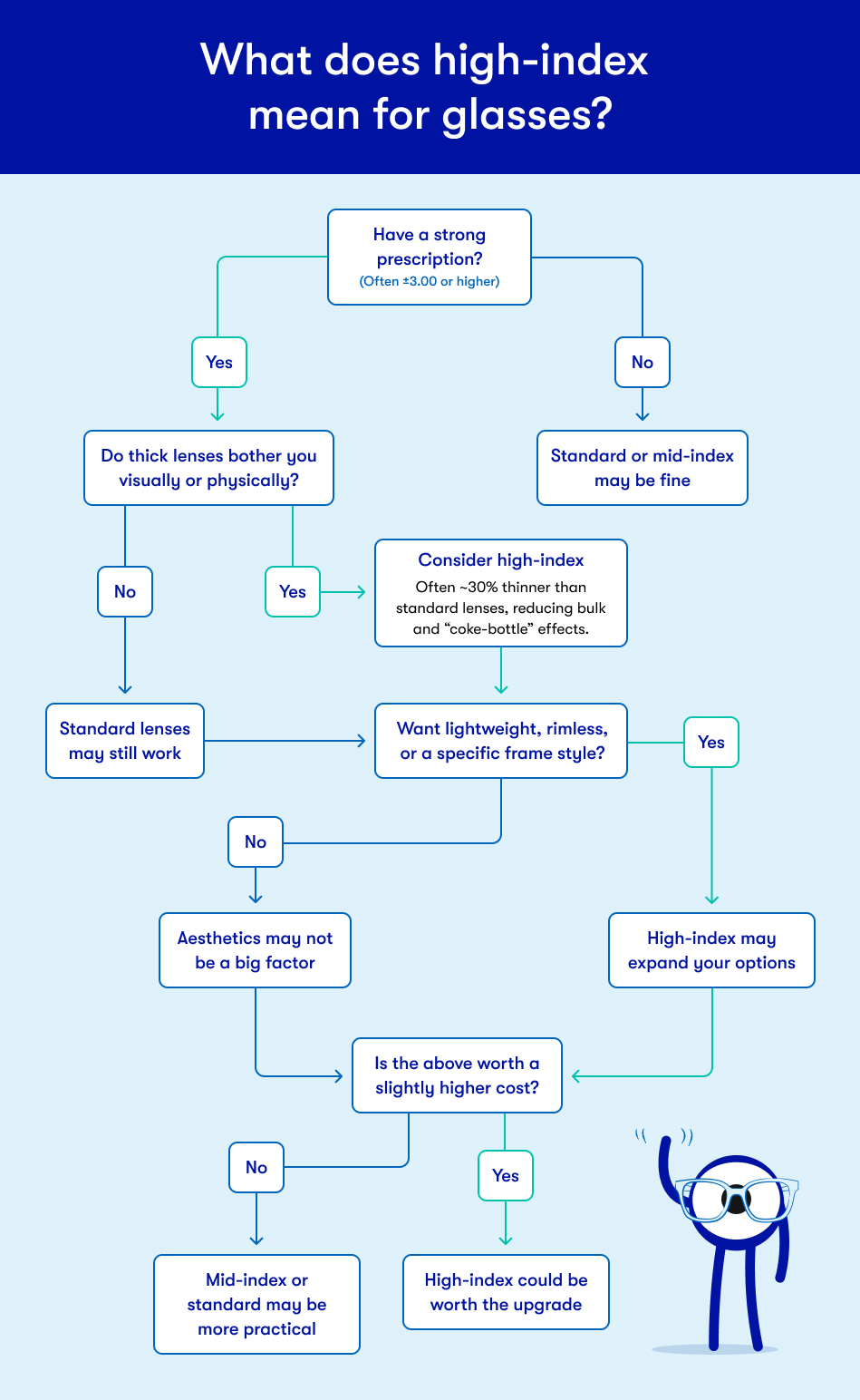
Benefits of high-index lenses
If you get a standard, mid-index, and high-index lens in the same prescription, the high-index lens will weigh less and be thinner than other options. The slimmer profile comes with numerous benefits for the wearer, such as:
-
More comfortable wearing experience: If you have a strong prescription, a higher-index lens can help reduce bulk and weight, making glasses more comfortable on the bridge of your nose. (No one wants those nose divets after long wear.)
-
Improved aesthetics: At lower indexes, lenses may need to be quite thick to accommodate stronger prescriptions, resulting in a coke-bottle or bug-eye look (when your eyes look especially large or the contours of your face take on fun house mirror proportions). Higher index lenses provide a better visual aesthetic.
-
Increased frame options: Very thick lenses may not fit well in certain frames, such as wire or half-rimless options. With high-index lenses, you may have access to more frame choices.
-
Potentially better clarity: More efficient light bending may reduce distortion, supporting better visual clarity through the lenses.
Potential disadvantages of high-index lenses
Why doesn't everyone opt for high-index lenses if they're so fantastic? They're not right for everyone, and they come with some potential downsides, including:
-
Increased costs: You may pay more for higher index lenses. For example, when comparing standard vs. mid-index vs. high-index glasses, you can expect average prices to increase as the index does.
-
More scratch-prone: The light-weight materials used to create high-index lenses are less durable than standard options. The higher you go on the spectrum, the more likely you may deal with scratch-prone lenses. Most eye care professionals recommend getting scratch-resistant coating on such lenses, and many won't sell high-index lenses without these coatings.
-
Less durable: Some higher-index lens materials are more brittle than lower-index options, making them less ideal for children who need glasses or for individuals who lead active, high-impact lifestyles.
Are high-index lenses better for astigmatism?
The efficient light refraction of high-index lenses can be helpful for those with astigmatism, especially when they have a strong prescription. Your eye care professional can offer recommendations about lens indexes that may best suit your vision correction needs and lifestyle.
The Framery at 1-800 Contacts
Get premium frames starting at $79
Shop glasses
Do high-index lenses scratch easily?
Yes, high-index lenses tend to be made of softer material than standard glasses lenses. For example, 1.59 lenses are usually polycarbonate, which are prone to scratching despite being impact resistant. In contrast, 1.50 lenses are made from CR-39 plastic, which is scratch-resistant.
In almost all cases, it's a good idea to get a scratch-resistant coating on your glasses to help protect them against minor scuffs. Knowing how to clean your eyeglasses and using the right materials, such as microfiber cloths, can help reduce the risks of scratches.
Do you really need high-index lenses?
When faced with the extra expense, you might wonder if high-index prescription glasses are really necessary. Consider the fact that you may wear your glasses every day for hours and how much aesthetics and comfort are worth. You may need high-index lenses if:
-
You have a strong prescription, and you don't like a lot of weight on your nose or face.
-
You want to avoid the appearance of bulging eyes or facial distortions through thick lenses.
-
You really like the look or feel of frames that require thinner lenses.
With so many lens options to choose from, you can customize your eyewear to fit your personal look and lifestyle. Explore frame options to pair with lenses for vision correction that looks great on you as it helps you see the world around you.
Compare your vision insurance options. Find all the details you need to find the best coverage for your preferences and budget. Find out which frames are best for your face shape and which ones to avoid and why. Turn to celebrity examples and view a handy glasses face shape chart. See how to order glasses online and try frames on at home. Understand what information you'll need to order your glasses, plus what to avoid. Everything you need to know about ordering glasses online

Best vision insurance for contacts and glasses

What are the best glasses for your face shape?

Can you order glasses online with your prescription?