


What is farsightedness? (Hyperopia)
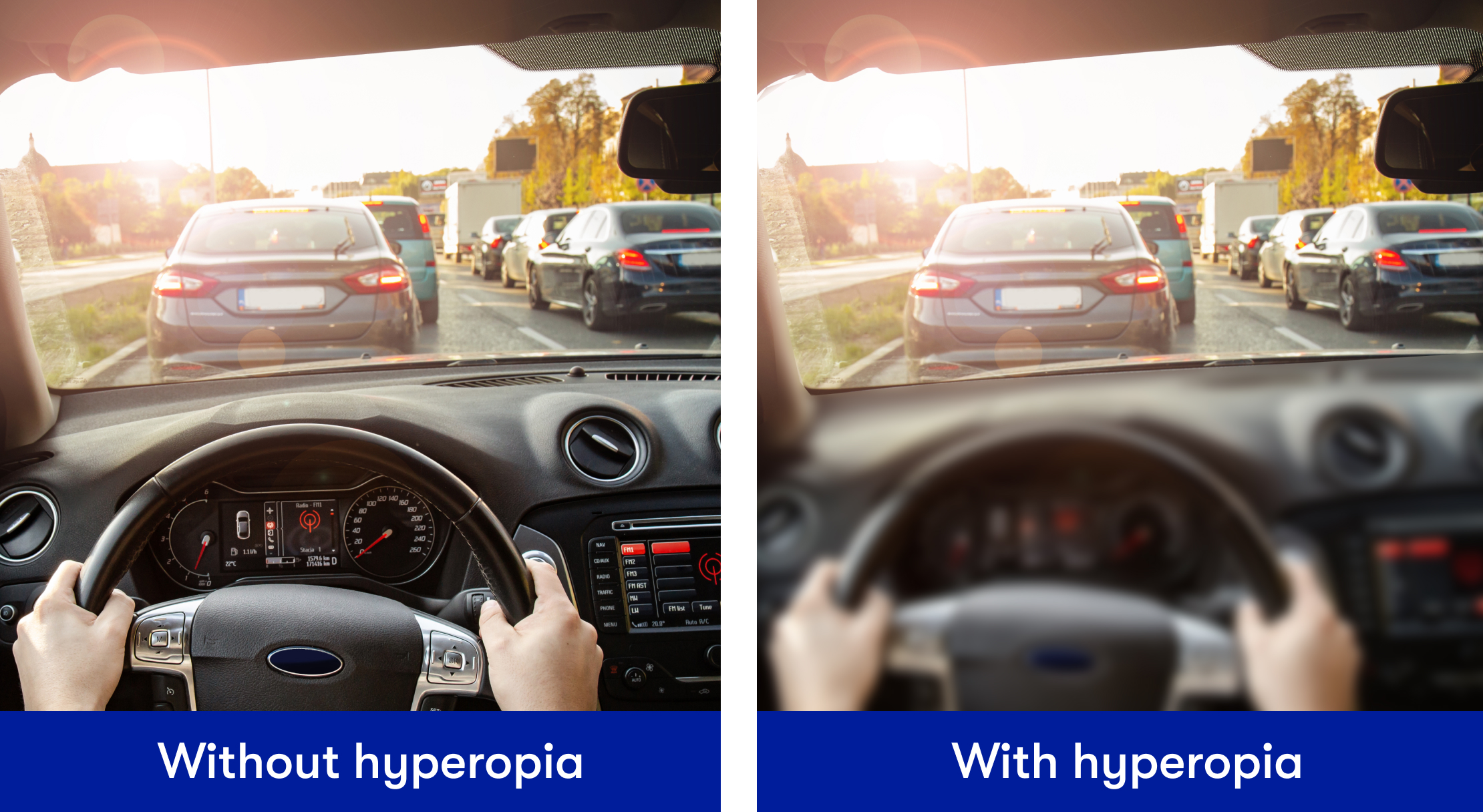
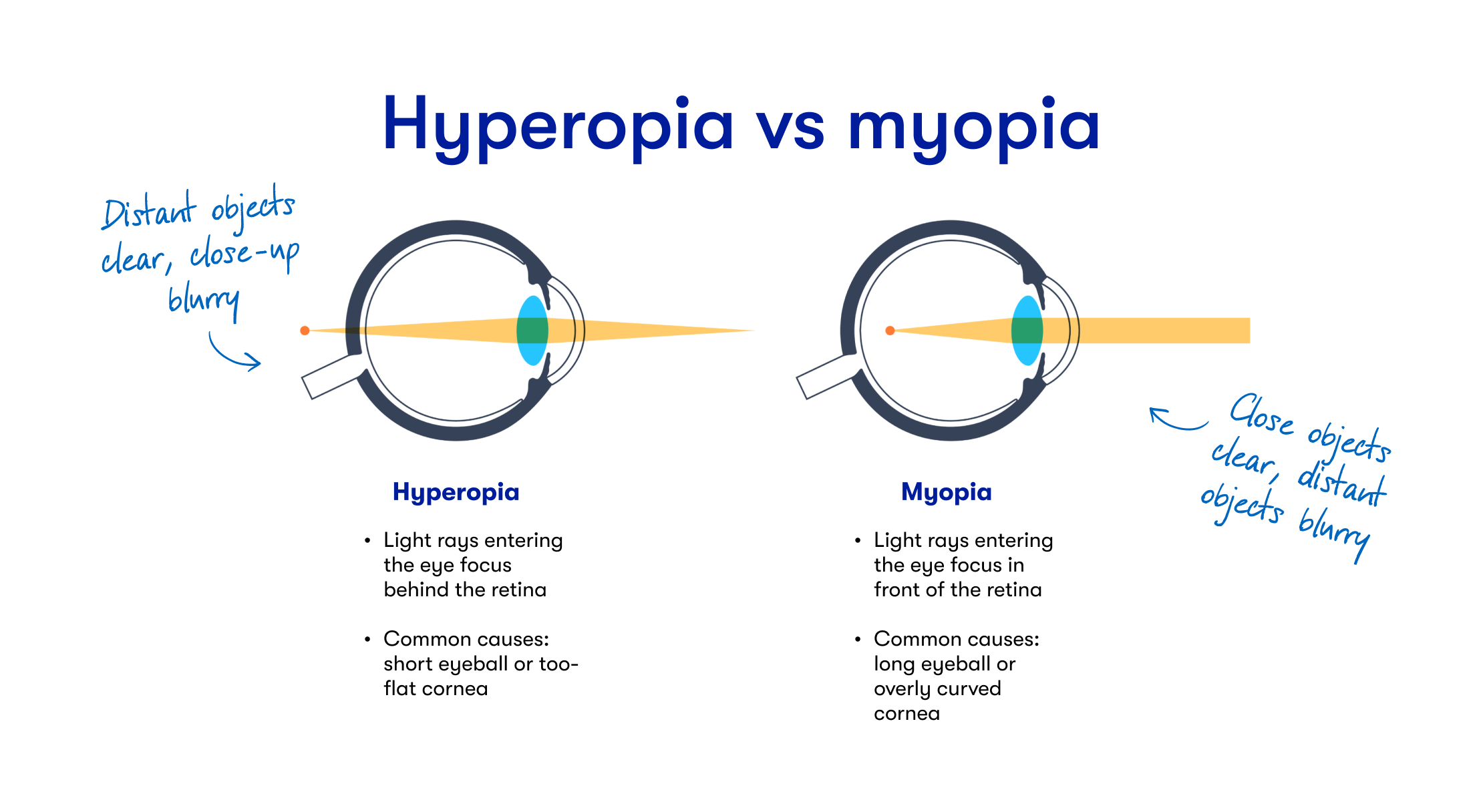
Farsightedness, or hyperopia, is an eye condition where you can see distant objects clearly, but objects close to you appear blurry. It happens if your eyeball isn't long enough from front to back or when your lens or cornea — the front surface of your eye — doesn't have enough of a curve. These issues cause light to focus behind the tissue at the back of your eye (also called your retina) instead of on it.
Symptoms of farsightedness include headaches, eye strain, and trouble focusing on nearby objects. Don't panic if you're noticing any of these issues — we know that's easier said than done. Farsightedness can be corrected with contacts, glasses, or possibly surgery.
Farsighted vs. nearsighted
People who are farsighted see faraway objects clearly, while people who are nearsighted have an easier time focusing on close-up objects. Both conditions are refractive errors, which means that the shape of your eye (or its individual parts) prevents it from focusing correctly. But while farsightedness causes the light to focus behind the retina, nearsightedness focuses the light in front of the retina.
Nearsightedness, or myopia, can happen if your eyeball is too long from front to back. (Isn't anatomy wild?) You might also be nearsighted if your cornea has too much of a curve or there's an issue with the shape of your lens.
Farsighted symptoms
If you're farsighted, your eyes are constantly struggling to focus on nearby objects. As a result, you might experience symptoms including:
-
Blurred up-close vision
-
Eye strain, fatigue, or discomfort
-
Squinting to focus
-
Headaches
Keep in mind that if you have mild farsightedness, you might not notice any of these symptoms — or, they may appear only after you've been reading or looking at your phone for a long time (another reason to stop doomscrolling). Small refractive errors can worsen with age, so symptoms can also appear as you get older.
Causes of farsightedness
Farsightedness is typically caused by two things:
-
Insufficiently curved cornea: In an eye with normal vision, the cornea has a smooth curve that focuses the light on the retina, the nerve tissue on the back inner surface of your eyeball. If your cornea has too shallow a curve, it moves the focal point farther back. As a result, your eyes have trouble focusing on things that are close by.
-
Short eyeball: When your eyeball is too short from front to back, the cornea and lens can't focus light correctly on the retina. It focuses too far back, resulting in blurry nearby vision.
Everyone is different; you might have a too-flat cornea, a short eyeball, or a combination of both.
Hyperopia treatment and farsighted correction
Farsightedness is usually treated with corrective lenses such as glasses or contacts. Depending on your condition, your eye care professional may also suggest a surgical option such as LASIK.
Contacts for farsightedness
Contacts for farsightedness help correct the curvature of your cornea with a lens that's thicker in the center and thinner on the sides. This outward curve helps focus light on your retina, allowing you to see nearby objects clearly. They're different from contacts for nearsightedness, which have a slight inward curve to move the focal point farther back.
If you're farsighted, your contact prescription will always have a plus sign in front of the PWR/SPH number. Higher numbers indicate a more pronounced curve.
As you're choosing contacts to correct hyperopia, consider what features you need to stay comfortable. If you have dry eyes, you might like lenses that moisturize and lubricate your eyes, such as ACUVUE® OASYS® 1-Day. If you want to wear your contacts for longer, a product like AIR OPTIX® plus HydraGlyde® might be more convenient.

Order Contact Lenses Online
Learn how to order contact lenses online at 1-800 Contacts
Order contacts
Glasses for hyperopia
As with contacts, glasses for hyperopia have a slight outward curve. It adjusts the way the light enters your eyes, so it can focus on the retina. Depending on any other eye issues you have, including presbyopia, your eye care professional might prescribe single-vision or bifocal glasses.
When you get an eyeglass prescription for farsightedness, it applies only to the lens itself. While strong prescriptions could limit your options somewhat, you can usually choose from a wide range of eyeglass frames to suit your personal style. (This is where it gets fun.) Whether you want classic rectangle glasses or bold geometric frames, there's an option for everyone.
Surgical options
If you don't want to wear contacts or glasses, your eye care professional may recommend refractive eye surgery. Procedures like LASIK or photorefractive keratectomy (PRK) can change the shape of your cornea and allow it to focus correctly.
Surgery can correct your vision quickly and safely, enabling you to see clearly without corrective lenses. (Yes, this means you can avoid those small indents on your nose or participate in high-impact sports without the added eyeglass accessory.) On the flip side, it can be expensive, and you could end up with side effects, including dryness and temporary problems with night vision.
You might be a good candidate for surgery if your vision prescription is stable and your eyes are healthy. If your corneas are too thin or if you have other eye conditions, LASIK and PRK may not be a good fit. The same goes if you already have dry eyes or if your lens prescription has changed recently.
Have you already celebrated your 40th birthday? Your eye care professional will likely check for presbyopia — (completely normal) age-related changes in up-close vision — before making a surgical recommendation.
Can farsightedness be cured?
Farsightedness can technically be cured with eye surgery. However, it's important to note that LASIK doesn't always last forever, so you might need a touch-up later on.
Can you grow out of farsightedness? Yes, but that usually only happens to children. Mild cases of hyperopia can resolve themselves as the child's eye develops.
Even though farsightedness is a permanent condition for most adults, it's pretty easy to treat. Corrective lenses help your eyes focus, and surgery might be an option if you want a more permanent fix. With the right pair of glasses or contacts, you can regain your close-up vision — and get rid of those reading-induced headaches simultaneously.
Ready to buy contacts for farsightedness? Visit 1-800 Contacts to find the same brand of contacts your eye care professional prescribed.
See how to get free shipping on affordable lenses, as well as the time it takes to get them and how to save time and money on the entire process. How much are contact lenses? Compare the prices of daily, weekly, biweekly, and monthly contact lenses and find the best option for you. See where to order contacts online, according to price and shipping times. Compare top online retailers to find the best deal for you. Everything you need to know about contact lenses
Free shipping for contact lenses

How much do contacts cost?

Where to order contacts online