



Optima Contacts
The easiest way to save on contact lenses®
Bausch + Lomb Optima and SofLens 38 contact lenses
Finding the right contact lenses can sometimes feel a bit confusing, especially when names and packaging change over time. If you have been prescribed Bausch + Lomb lenses and are trying to navigate between Optima and SofLens 38, you are in the right place. Whether you have worn these brands for years or are just filling a new prescription, this guide breaks down everything you need to know about these time-tested lenses.
Understanding the Optima and SofLens 38 family
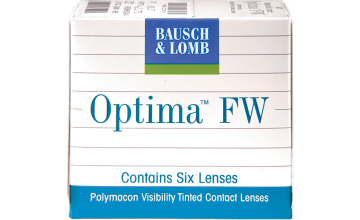
For many years, Bausch + Lomb has manufactured reliable soft contact lenses that prioritize clear vision and comfort. The confusion for many wearers often stems from the naming conventions. It is helpful to know that Optima FW and SofLens 38 are essentially the same lens. Bausch + Lomb rebranded the Optima FW as SofLens 38, so if your doctor wrote a prescription for one, you can generally use it to purchase the other, as the parameters and material (Polymacon) remain identical.
These lenses are known for their ultra-thin design and deposit-resistant surface. They are made from a time-tested material called Polymacon, which has a water content of 38%. This lower water content can be beneficial for people who experience dry eyes, as the lens absorbs less moisture from your tear film compared to high-water content lenses.
Key features of SofLens 38 (formerly Optima FW)
SofLens 38 contact lenses are designed for daily wear. This means you put them in at the start of your day and take them out before you go to sleep. They are capable of correcting nearsightedness (myopia) and farsightedness (hyperopia).
- Reverse Process III technology: This manufacturing process creates an ultra-thin design that improves comfort and ensures the lens sits properly on your eye.
- Visibility tint: These lenses come with a light blue visibility tint. This tint does not change your eye color but makes it much easier to see the lens in the solution case or on your finger during insertion.
- Deposit resistance: The Polymacon material resists the build-up of protein and lipids, which helps keep your vision clear and your eyes comfortable throughout the wearing cycle.
Optima Toric for astigmatism
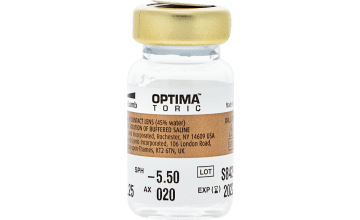
If you have astigmatism, your doctor may have prescribed Optima Toric lenses. Unlike standard spherical lenses, toric lenses have different powers in different meridians of the lens to correct the irregular curvature of your cornea.
Optima Toric lenses are known for their stability. For a toric lens to work well, it must stay in the correct position on your eye without rotating excessively when you blink. Bausch + Lomb designed these lenses to provide excellent stability, ensuring your vision remains sharp and consistent all day. Like the SofLens 38, they are made from low-water content material to support comfortable daily wear.
Differences between Optima 38/SP and SofLens 38
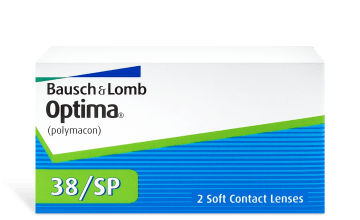
You might also come across Optima 38/SP. While similar to SofLens 38, the "SP" stands for "Spare Pair." These were traditionally marketed differently but share the same core characteristics: a 38% water content and the Polymacon material. However, always stick to the specific brand and model written on your prescription. Even small differences in base curve or diameter can affect how the lens fits. If you are unsure if you can switch between Optima 38/SP and SofLens 38, it is best to check with your eye care professional first.
How to read your prescription
Ordering online is easy once you understand the numbers on your box or prescription.
- Power (PWR/SPH): This number indicates the strength of your correction. It will have a plus (+) for farsightedness or a minus (-) for nearsightedness.
- Base Curve (BC): This measures the curvature of the lens. Common numbers for these lenses are 8.4, 8.7, or 9.0. Getting this right is crucial for a comfortable fit.
- Diameter (DIA): This is the width of the lens, usually around 14.0 mm for these brands.
- For toric lenses: You'll see two additional numbers: Cylinder (CYL), which is the degree of astigmatism correction, and Axis (AX), which indicates the orientation of the cylinder power.
Caring for your lenses
Since these are planned replacement lenses (often bi-weekly or monthly, depending on your doctor's advice), proper care is essential. Always use a high-quality multi-purpose solution or hydrogen peroxide cleaning system to clean and disinfect your lenses after every use. Never use tap water or saliva, as this can introduce harmful bacteria to your eyes. Replacing your lens case every three months is also a smart habit to prevent infection.
Why buy online?
Purchasing your Optima or SofLens 38 contacts online offers convenience and often better pricing than buying directly from a doctor's office. You can easily compare prices, access rebates for buying in bulk (like an annual supply), and set up auto-shipments so you never run out. All you need is a valid prescription. We verify every order to ensure you receive the exact lenses your doctor prescribed for your eye health and safety.